Cloudy Pool Water That Won't Clear? Common Causes and Fixes
Quick Answer:
Cloudy pool water that won't clear almost always comes down to one of five things: low or “used up” sanitizer, imbalanced pH or total alkalinity, a dirty or undersized filter, organic waste from swimmers and storms, or early-stage algae that hasn't turned green yet. Start by testing free chlorine, pH, and total alkalinity, since those numbers point you toward the right fix. If chemistry checks out, the filter is almost always next — a clogged filter can't strain out the fine particles that make water look hazy no matter how much chemical you add. Most cloudy pools clear within 24 to 72 hours once the actual cause is corrected and the pump runs continuously through the fix.
You test the water. The numbers look fine. And the pool still has that milky, unfocused look, like someone poured a splash of skim milk into the deep end. It's one of the more frustrating pool problems out there, because the fix isn't always obvious from the surface. A pool can be low on chlorine and cloudy, or loaded with chlorine and still cloudy — and which one you're dealing with changes what you do next.
This isn't just a cosmetic problem. Water you can't see through a few feet down is a safety issue, since parents and anyone watching swimmers rely on visibility to spot trouble under the surface. North Texas summers push chemical demand higher than a lot of the country deals with, and the region's hard water adds a wrinkle most cloudy-water articles skip over entirely. Once you know what's actually causing the haze, clearing it stops being guesswork.
What's Actually Happening When a Pool Turns Cloudy
Cloudy water is a filtration problem before it's anything else — a soup of particles too small for your filter to catch on its own. Dead algae cells, mineral deposits, pollen, sunscreen residue, chlorine byproducts. Each one is small enough to stay suspended in the water instead of settling out or getting trapped in the filter media. The water isn't dirty the way a muddy puddle is dirty. It's carrying a fine haze that scatters light instead of letting it pass through.
That's why testing chemistry alone doesn't always solve it. Your sanitizer level can read perfectly in range while the filter is too clogged to pull out what's already suspended. Or the chemistry looks fine on paper while sub-visible algae quietly eats through chlorine faster than a test strip can catch. Clearing the water means figuring out which mechanism is active and treating that specific cause — not throwing every pool chemical at it and hoping something sticks.
The Most Common Causes Behind a Pool That Won't Clear
Sanitizer demand outrunning supply
Chlorine, from a feeder or salt cell, constantly oxidizes bather waste, sunscreen, leaves, and airborne contaminants. Fort Worth summers bring longer swim hours and triple-digit heat, pushing chlorine demand up fast toward zero free chlorine.
pH, alkalinity, or calcium hardness drifting out of range
North Texas tap water runs hard, carrying more dissolved calcium than water elsewhere. When pH or alkalinity climbs too high, calcium precipitates into microscopic particles, scattering light like organic haze, though the fix differs completely.
A filter that's dirty, undersized, or running too few hours
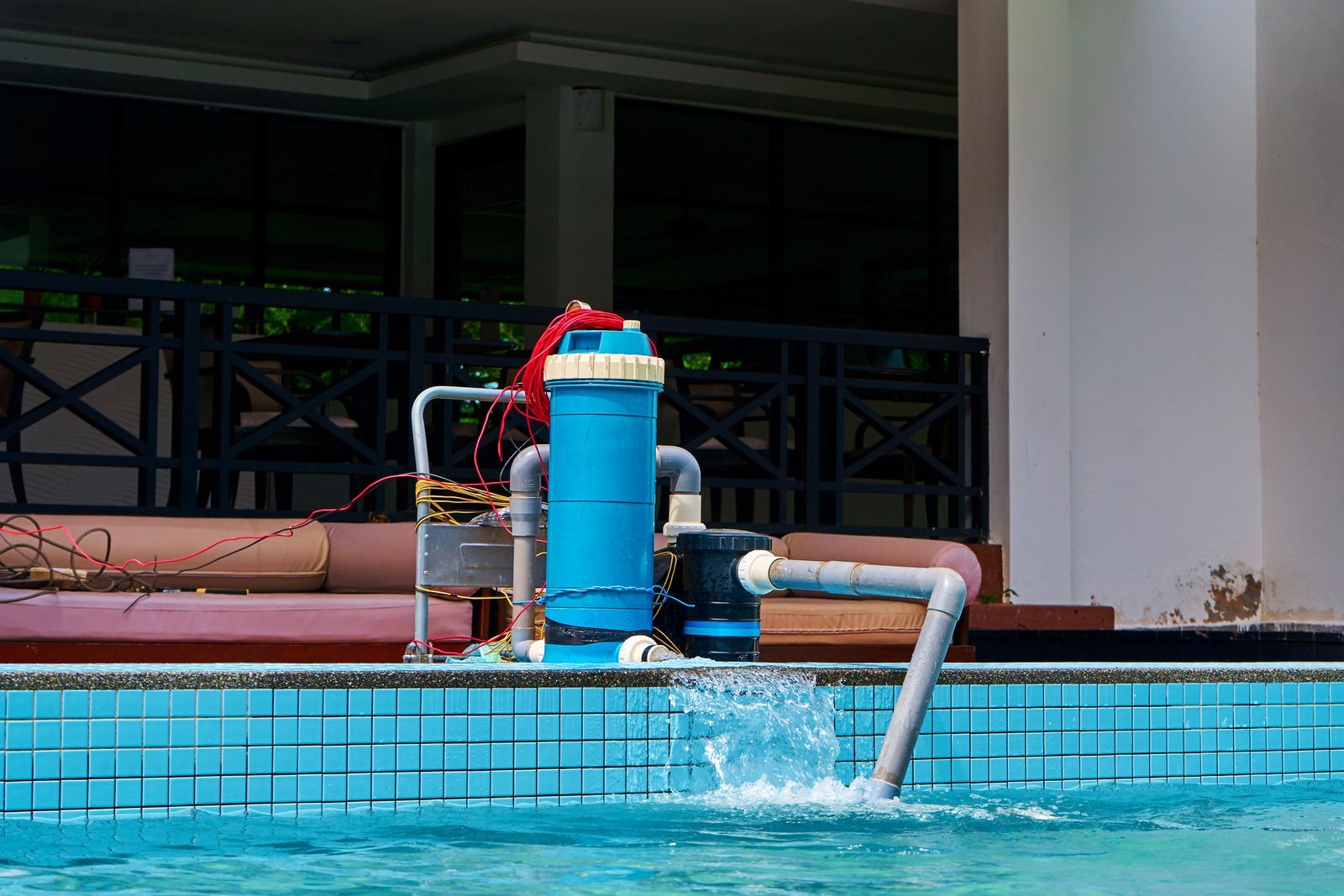
Sand, cartridge, and DE filters lose efficiency as oils, sunscreen, and fine debris load them up. A filter that looks clean after a rinse can still be too fouled to trap the particles causing haze.
Bather load and organic contamination
Sweat, body oils, cosmetics, sunscreen, and lotion enter the water with every swimmer, and one pool party can dump more organic load than a normal week of use. That eats sanitizer, leaving dulling chloramines behind.
Storm runoff and environmental debris
Wind-driven pollen, construction dust, and heavy spring rain carry fine particulate into an open pool. DFW storm season often lands as pools open for the year so a clear pool Friday turns hazy by Monday.
How to Figure Out Which Cause You're Dealing With
Start with a full test, not just chlorine
Test free chlorine, total chlorine, pH, total alkalinity, and calcium hardness. A gap between free and total chlorine, often called combined chlorine, points toward organic contamination and chloramines rather than a simple low-chlorine situation.
Check the filter pressure gauge
Compare the current reading against the pressure right after the filter was last cleaned. A rise of 8 to 10 psi above that baseline means the filter is restricting flow and needs cleaning or backwashing before anything else stands a chance of working.
Look at recent history
A cloud that showed up right after a storm or a big pool day points toward organic load. A gradual haze that built over a week or two, with no obvious trigger, more often traces back to filtration or chemistry drift.
Rule out early algae
Sub-visible algae doesn't always show green right away. If chemistry and the filter both check out and the water still won't clear, brush the walls and floor and look for a fine dusty film before assuming the cause is purely mechanical.
TIP: Write down the filter pressure reading every time you clean it, and keep that number somewhere you'll actually see it — a sticky note on the equipment pad works fine. That baseline is what makes the 8-to-10-psi rule useful. Without it, you're just guessing at whether today's reading counts as high.
Fixing Cloudy Water Step by Step
Balance the water first
Correct pH toward 7.2 to 7.6 and total alkalinity toward 80 to 120 parts per million before anything else. Chemicals added to unbalanced water don't perform the way the label promises, so skipping this step wastes both time and product on every fix that follows.
Shock the pool if chlorine demand is the driver
A chlorine shock rapidly raises free chlorine high enough to oxidize the organic waste and chloramines dulling the water. Some temporary clouding during shocking is normal — that's oxidation doing its job — and it should start clearing within a day once the shock finishes working.
Clean or replace the filter media
Backwashing a sand filter removes loose debris but doesn't strip oils and scale bonded to the sand grains themselves. A degreasing filter cleaner handles that buildup properly. Sand or cartridge media that's several years old and still struggling after a real cleaning is usually past its useful life.
Run the pump continuously until the water clears
Turning the full pool volume over more than once a day speeds up recovery compared to a normal maintenance schedule, sometimes by a couple of days. Once the water clears and holds steady, the system can go back to its regular run time.
Use a clarifier or flocculant for a stubborn haze
Clarifier binds fine particles together so the filter can trap them, and it works well when the pool bottom is still visible and chemistry is already in range. Flocculant works faster by dropping particles to the floor for vacuuming — better suited to water so cloudy you can't see the bottom at all — but it needs a filter system set up for vacuum-to-waste.
Most pools respond to the right combination of these steps within one to three days. Water still hazy after that window, despite correct chemistry and a clean filter, usually points to something mechanical: a circulation dead zone, an undersized pump, or a filter that's simply too small for the pool's volume. That's worth having a professional look at rather than treating with more chemicals.
WARNING: A cloudy pool is more than an inconvenience. Reduced visibility hides submerged hazards, makes it harder to spot a swimmer in distress, and often coincides with a sanitizer level too low to protect against bacteria. Treat a persistently cloudy pool as off-limits for swimming until the water is clear and testing confirms chemistry is back in range — not just improving.
Frequently Asked Questions
Why is my pool cloudy even though the chlorine level tests fine?
A normal free chlorine reading doesn't rule out contamination. Chloramines, formed when chlorine reacts with sweat and oils, dull clarity while chlorine looks fine. A gap between free and total chlorine points to this cause.
How long should it take for cloudy water to clear after treatment?
Most pools clear within 24 to 72 hours once the cause is fixed and the pump runs continuously. Clarifier fixes trend slower. Flocculant with vacuuming clears a pool faster, within a day. Otherwise, recheck it.
Is it safe to swim in a slightly cloudy pool?
No. Reduced visibility makes it harder to spot a swimmer below the surface or hazards on the floor, and cloudiness often means low sanitizer. Treat any cloudy pool as closed until tests confirm clear water.
What's the real difference between pool clarifier and flocculant?
Clarifier clumps fine particles so the filter can capture them over a day or two, with no extra labor. Flocculant works faster, dropping particles to the floor in hours, but requires vacuuming and a filter.
Does Fort Worth's hard water make cloudy pools more common here than elsewhere?
Hard water raises calcium hardness faster than softer municipal supplies, and high calcium with high pH commonly causes cloudy, scale-forming water here. Pools filled from well water or mineral-heavy sources need hardness testing more often.
Why does my pool get cloudy every time it rains?
Wind and rain carry pollen, dust, and debris into an open pool faster than filtration can process, while heavy rain dilutes sanitizer too. A bump in run time after a storm usually clears this haze.
New Title
Getting Back to Clear Water for Good
A pool that won't clear is almost never a mystery once the testing happens in the right order: chemistry first, filtration second, then a look at bather load and recent weather. The pools that stay clear all season aren't the ones that never have a cloudy day. They're the ones with an owner who catches the early signs and knows which of the five causes is actually in play before reaching for a chemical. Getting the diagnosis right the first time saves both money and the days of lost pool use that come from guessing.
A hazy pool that won't clear on its own is worth a professional look at chemistry, filtration, and circulation together, not another round of guesswork with clarifier and shock. Blazin Blue Pool Service, serving Fort Worth, Texas, brings 20+ years of hands-on experience and full-service capability spanning
routine maintenance, equipment repair, leak detection, and pool builds. Schedule a maintenance visit and get a clear answer on why the water won't clear along with a plan to keep it that way.